Francis Bacon
Painting, 1946
Oil and tempera on canvas
123x105.5cm.
Private collection
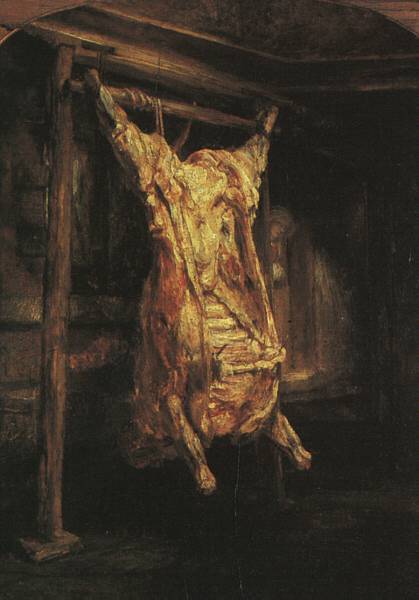
| Figure Study II, led to the Great butcher's shop image Painting, 1946, in its palatte and in its use of an open umbrella as a dominant image. The painting's progress took it through several mutations. At first it had a landscape setting, initially in an image of a chimpanzee in long grass, next to an image of a large bird of prey alighting on a field. "Suddenly the lines that I'd drawn suggested something totally different, and out of this suggestion arose this picture.' The scene is an old fashioned butcher's shop with ceramic festoons on the walls and, looming up in the background, a carcass which - like the Rembrandt caracss [Slaughtered Ox] in the Louvre - is also a headless Crucifixion. In front of this, under an umbrella, is a figure which seems to be that of a politician (or even a Pope) addressing a battery of microphones; on either side of the foreground is a side of meat attached to a tubular structure evocative of gymnastic appratus and closely resembling Bacons Furniture designs of 1930.
The insistence on symmetry, the imitation of superior powers and the atmosphere of enactment of a ritual combine to give the work the look of an alterpiece with an overwhelming granduer of presence. That echo is one of many that overlap here, from past to recent art history; there is a long line of European painting streaching back to Rembrandt and Velazquez and Titian; there is the English eccentric-fantastic tradition, the tradition of Baudelaire evoked with his phrase about 'that indefinable breath of the sinister, the violent and the ruthless which characterizes almost every product of the land of slpeen'; there is surrealism. And there's an affinity to aspects of the new American painting in the freesdom of the handeling of the paint. The combination of that freedom in Painting, 1946, with frontal figuration of a domineering presence could even have influenced a major phenomenon in American painting of the 1950's. For Painting, 1946, was acquired in 1948 by the Museum of Modern Art, New York, and may well have, according to close students of de Kooning an avowed admirer of Bacons, helped to shape the sharp-toothed image of Woman I. Painting, 1946, that excellent resolution of the permanent opposition in Bacon's work between formality and chance, has one thing wrong with it. Manipulation of paint became an inexhaustible gamble for Bacon, involving all sorts of exploration of accident and chance, and often this included the use of addiditives such as dust, sand, cotton wool, candle wax, sprayed auto-mobile paint, Letraset, and, above all, the pastel used freely in this piece and many others. Unfortunately, in 1946 Bacon did not yet know what he later learned by chance, that when pastel is used along with oil paint it adheres better to the surface if the artist works on the reverse side of a primed canvas. Because he didn't know this when he executed Painting, 1946, it is now too fragiled to be moved. David Sylvester : "The image of sides of meat is obviously one that means a great deal to you." Francis Bacon: "Well, it does. But, of course, one has got to remember as a painter that there is this great beauty in the color of meat." David Sylvester "Indeed, of course, Rembrant used a carcass of beef hanging up almost as a stand-in for the Crucifion, intentionally or not." Francis Bacon: "I never think of that. And I never think of it as a carcass of beefe even. The odd thing is that I don't think that carcass of meat is one of Rembrant's great pictures, because I don't think it's very much like meat. It looks to me like a lump of wax hanging there. I don't think it's a great painting of meat. I don't know what the great paintings of meat are".
Extract from:
Looking Back at Francis Bacon |